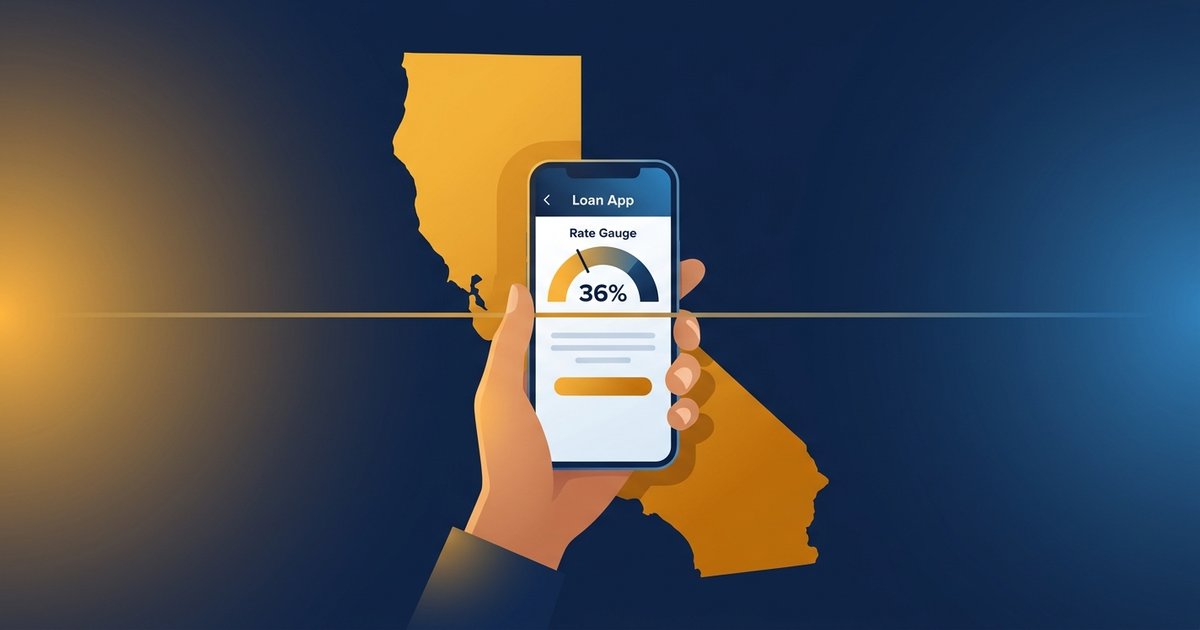

If you live in California and a loan app is charging you more than roughly 41% APR on an installment loan between $2,500 and $10,000, something is off, because state law caps that rate at 36% plus the Federal Funds Rate under the California Financing Law as amended by AB 539. That one sentence explains why your cousin in Nevada gets approved on apps that reject you, why your minimum term is 12 months when your coworker in Texas pays back in three, and why some apps you see advertised on TikTok quietly geofence the Golden State.
The One Number That Rewired California Lending: 36% Plus Fed Funds
AB 539, signed by Governor Newsom in October 2019 and effective January 1, 2020, rewrote the California Financing Law (Financial Code Division 9, Chapter 3) to cap interest on consumer loans between $2,500 and $10,000 at 36% simple interest plus the Federal Funds Rate.
The Fed Funds piece is the part most articles skip. California uses the rate published in the Federal Reserve's H.15 release on the first day of the month preceding the month your loan is consummated. With the Fed Funds Rate sitting in the mid-4% range through early 2026, the practical ceiling on a $5,000 installment loan from a California Financing Law licensee is roughly 40.5% APR, not a flat 36%.
Here is what that means for your wallet: a $5,000 loan at 40.5% APR over 36 months carries a monthly payment near $215, and you pay about $2,740 in interest over the life of the loan. That is expensive money. It is also a fraction of what borrowers in Texas or Utah pay on the same size loan through a CAB or tribal-model lender.
Which Loan Sizes the Cap Actually Covers
This is where people get tripped up. AB 539's hard cap applies to loans of $2,500 to $10,000. Loans under $2,500 fall outside AB 539's rate cap, which is why you still see small-dollar products in California advertising APRs above 100%. Loans over $10,000 are also outside the rate cap, though lenders face other California Financing Law restrictions.
A few other things CFL licensees making loans in the $2,500 to $10,000 band must do under the post-AB 539 rules:
- Offer a minimum 12-month term on any loan under $3,000
- Provide a credit-education program to the borrower
- Charge no prepayment penalty, ever
- Report repayment to at least one national consumer reporting agency
That 12-month minimum is why the app you tried felt slower. It is not a quirk of the product. It is statute.
DFPI: The Regulator With Teeth
The California Department of Financial Protection and Innovation (DFPI) is the agency that writes the rules, issues CFL licenses, and signs consent orders. You can verify a license through the DFPI licensee search or file a complaint directly. Under the California Consumer Financial Protection Law (CCFPL), in effect since 2021, DFPI also has broad UDAAP authority over fintech products that previously slipped between federal and state cracks.
Two DFPI actions matter most when you are picking an app in 2026.
SoLo Funds Consent Order (May 2023)
DFPI hit SoLo Funds with a $50,000 penalty and required the company to refund every "donation" and "tip" collected from California borrowers. The underlying theory mattered more than the dollar figure: California treats tips and donations on peer-to-peer loans as finance charges. If your app's business model depends on voluntary tips that are not really voluntary, California does not see them the way the app sees them. SoLo stopped lending in California well before the order, and you will not find its peer-to-peer product available here now.
DFPI Income-Based Advances Registration (Effective February 15, 2025)
This is the rule that reshaped earned wage access in California. Under CCFPL authority, DFPI now requires EWA providers, including tip-model and donation-model products, to register through NMLS and file quarterly reports. Providers that did not complete registration either exited California or restructured their California products.
The OppFi Ruling and the Bank-Partner Question
On February 24, 2026, the Los Angeles County Superior Court granted summary judgment for OppFi against DFPI, rejecting the state's "true lender" theory on loans originated by FinWise Bank and serviced by OppFi. For now, the ruling means the bank-partner model survives in California, and OppLoans remains available to California borrowers at APRs above the AB 539 cap.
A caveat worth noting: DFPI has signaled intent to appeal, and the appellate path could still reshape this. If you are reading this more than a few months after publication, verify OppLoans's California status on the app itself before you apply. The in-app state disclosure is the source of truth.
Loan Apps Available in California Right Now
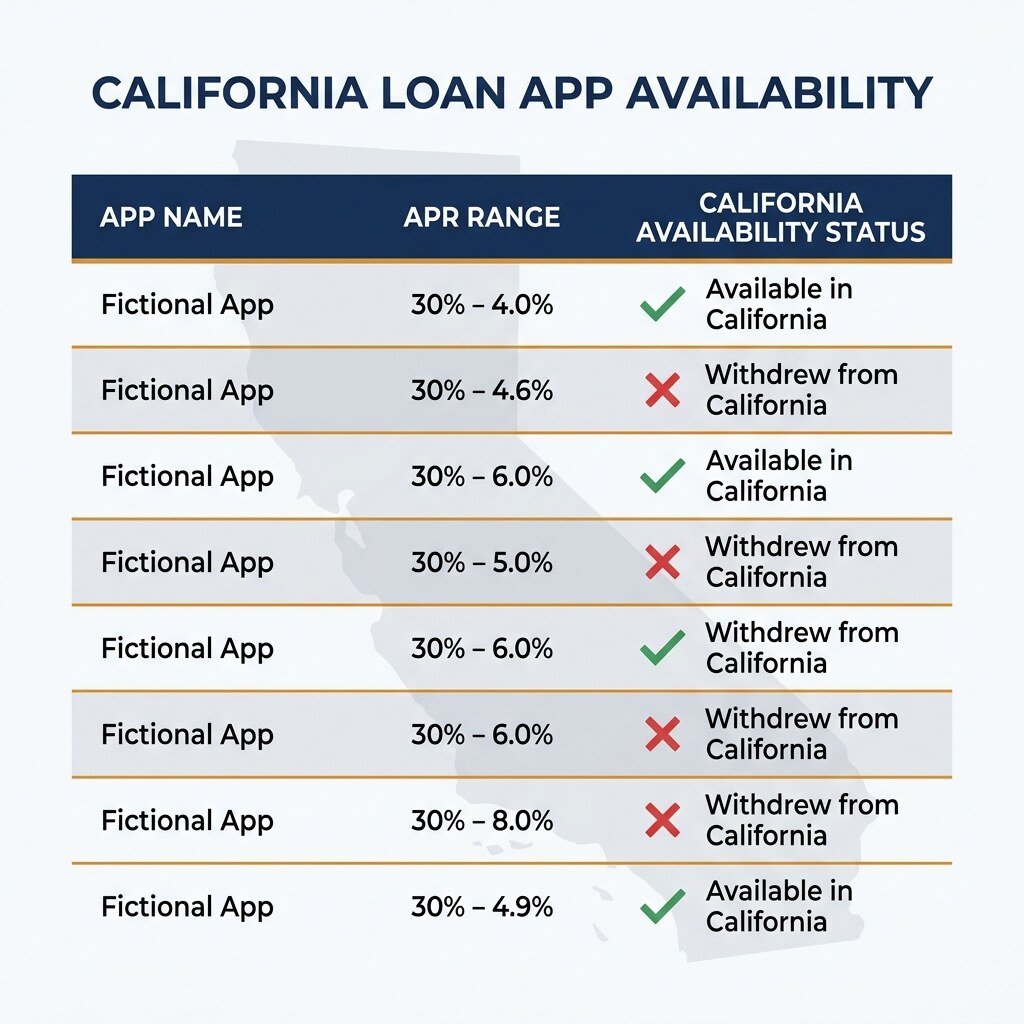
The following apps operate in California under CFL licenses or equivalent compliance structures. All were verified to be accepting California applicants as of publication. Your experience may differ based on credit profile and residency verification.
| App | CA Status | Model | Loan Size / Advance | Max APR (CA) |
|---|---|---|---|---|
| LendingClub | Available | CFL licensed | $1,000 to $40,000 | Capped at 35.99% |
| Upgrade | Available | CFL licensed | $1,000 to $50,000 | Roughly 36% plus Fed Funds on covered band |
| SoFi | Available | CFL licensed, prime-focused | $5,000 to $100,000 | Well below cap |
| Upstart | Available | Bank partner plus CFL | $1,000 to $50,000 | Capped at 36% plus FFR on covered band |
| Happy Money | Available | Credit-union partner | $5,000 to $40,000 | Well below cap |
| Best Egg | Available | Bank partner | $2,000 to $50,000 | Capped at 35.99% |
| OppLoans (OppFi) | Available, contested | Bank-partner model | Up to $4,000 | Above AB 539 cap; see OppFi ruling |
| Possible Finance | Available | CFL licensed, small-dollar | Up to $500 | Outside AB 539 band, high APR |
| DailyPay, Payactiv, Brigit (EWA) | Available | Registered under DFPI EWA rule | Earned wages | Product-specific; not a traditional APR |
Re-verify before you sign. App Store and Google Play ratings at time of writing run in the 4.4 to 4.8 range for most of these, which tells you more about UX than about pricing. Read the California state disclosure screen, not the star count.
Apps That Quietly Left California
You will see these advertised on podcasts and in social feeds, but they either will not approve you with a California address or will offer a materially different product:
- SoLo Funds (peer-to-peer): not lending in California following the 2023 DFPI consent order
- Several tribal-affiliated installment products that priced well above the AB 539 cap
- EWA products that did not complete DFPI registration by the February 2025 effective date
If an app asks for your address and then suddenly tells you "we are not currently lending in your state," that is almost always AB 539 or CCFPL doing its job. The app is not broken. The math just does not pencil out under California law.
Earned Wage Access After the 2025 Rule
Before February 15, 2025, EWA in California lived in regulatory gray space. Some providers operated under 2021 MOUs with DFPI. Others simply operated. The new registration rule ended that. Products you may still see in California from registered providers include DailyPay, Payactiv, Even, Bridgit, and a growing list of post-2025 registrants.
What changed for you as a borrower: disclosures are clearer, tip and expedite-fee ceilings are tighter, and the state reserves the right to treat an advance as a loan for APR-calculation purposes. That last piece is what pushed several tip-heavy EWA apps to restructure their California flow.
How to File a DFPI Complaint
If you believe a loan app charged you above the AB 539 ceiling, collected an unregistered EWA tip, or misrepresented its California license status, you have a clear path:
- Gather your loan agreement, the app's state disclosure screen, and any payment history
- File online at the DFPI Consumer Complaint portal
- Keep a copy of the confirmation email; DFPI investigators will contact you if they open a case
- If the loan was pitched to an active-duty servicemember, file a parallel Military Lending Act complaint with the CFPB
California borrowers file tens of thousands of complaints a year. The ones that move fastest include a copy of the loan contract and a specific citation to the statute the lender appears to have violated.
Your Next Steps if You're Borrowing in California
Before you tap "agree" on any loan app in California, do three things. Verify the lender's CFL license in DFPI DocQnet (search by entity name). Read the California state-specific disclosure screen inside the app, not the generic marketing copy. And calculate your total cost: principal, monthly payment, total payments over the full term. If the math exceeds what 36% plus the current Fed Funds Rate would produce on a loan in the covered band, ask why, and get the answer in writing.
Common questions from readers.
Short answers to the questions we get by email after this article publishes.
01 Does California's 36% APR cap apply to every loan app?
No. AB 539's hard cap applies to California Financing Law licensees making consumer loans between $2,500 and $10,000. Loans under $2,500, loans over $10,000, bank-originated loans, and certain federally preempted products fall outside its scope. Always check the app's California-specific disclosure screen for the rate that applies to your loan size.
02 Why do some loan apps say "not available in California"?
Most often the app's pricing model cannot survive under AB 539, the California Consumer Financial Protection Law, or DFPI's 2025 earned wage access registration rule. Rather than redesign the product for one state, the company geofences California. It is not a bug; it is a business decision driven by California's stricter consumer protections.
03 What happened in the OppFi v. DFPI case?
On February 24, 2026, the Los Angeles County Superior Court granted summary judgment for OppFi, rejecting DFPI's claim that OppFi was the true lender on FinWise-originated loans and therefore subject to AB 539. For now, OppLoans continues to operate in California at APRs above 36%. DFPI may appeal, so verify current status before applying.
04 How do I report a loan app that charged me too much in California?
File a complaint with the California Department of Financial Protection and Innovation at dfpi.ca.gov/file-a-complaint. Include your loan agreement, the app's state disclosure, and payment records. If you are an active-duty servicemember, also file a Military Lending Act complaint with the CFPB, since federal MLA protections cap APR at 36% all-in.
05 Are earned wage access apps legal in California?
Yes, but only if the provider registered with DFPI under the Income-Based Advances rule that took effect February 15, 2025. California classifies EWA transactions, including tip and donation models, as loans for regulatory purposes. Registered providers include DailyPay, Payactiv, and others listed in DFPI's NMLS registry.