
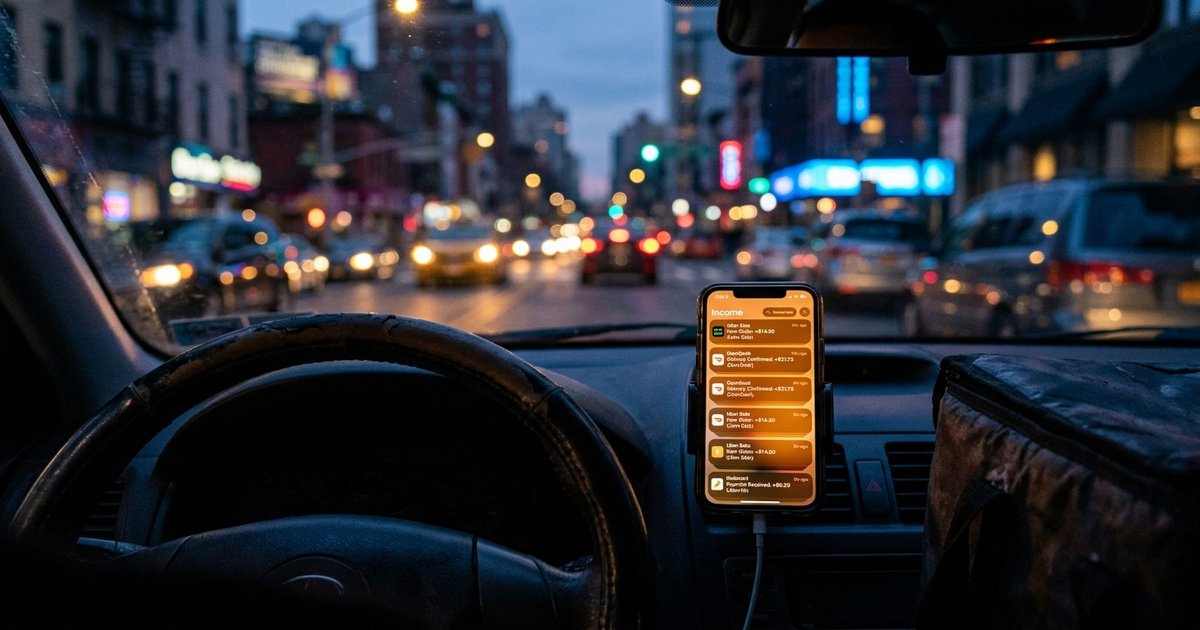
The best loan apps for gig workers in 2026 are the ones built around 1099 deposit patterns instead of biweekly W-2 direct deposits: Giggle Finance for Uber, Lyft, DoorDash, and Instacart earners who need up to $10,000 in minutes, MoneyLion Instacash for smaller $25 to $500 advances parsed through Finicity, and Possible Finance for short installment loans that actually build credit. The apps most articles still recommend (Earnin and Dave) quietly reject most rideshare and delivery workers because their verification logic assumes a fixed employer and a fixed workplace, neither of which a gig driver has. This guide sorts which apps approve gig income, which only pretend to, and what paperwork you need ready before you apply.
Why Most Loan Apps Quietly Reject Gig Income
Cash advance apps were built around one model: a single W-2 biweekly direct deposit from a single employer. Underwriting (the kind of deposit-flow analysis the CFPB has documented) reads that pattern in under a second, confirms the next deposit's expected date and amount, and extends a percentage of it as an advance. Everything the app does flows from that assumption.
Gig income breaks the model in three ways. Uber and Lyft pay daily or weekly at variable amounts. DoorDash and Instacart sweep batch earnings and tips on unpredictable schedules. Rideshare and delivery workers often have two to four platforms depositing concurrently, producing a bank feed that looks less like a paycheck and more like small-business revenue.
Earnin's verification layer is the clearest example of the mismatch. The app verifies income through work email, timesheets, wage stubs, and GPS at a fixed work location. A rideshare driver does not have a work email. An Instacart shopper does not have a timesheet. A DoorDash driver's GPS traces a different route every hour. The app is not rejecting gig workers out of discrimination; it was simply not built for them.
How Plaid and Finicity Read an Uber or DoorDash Deposit
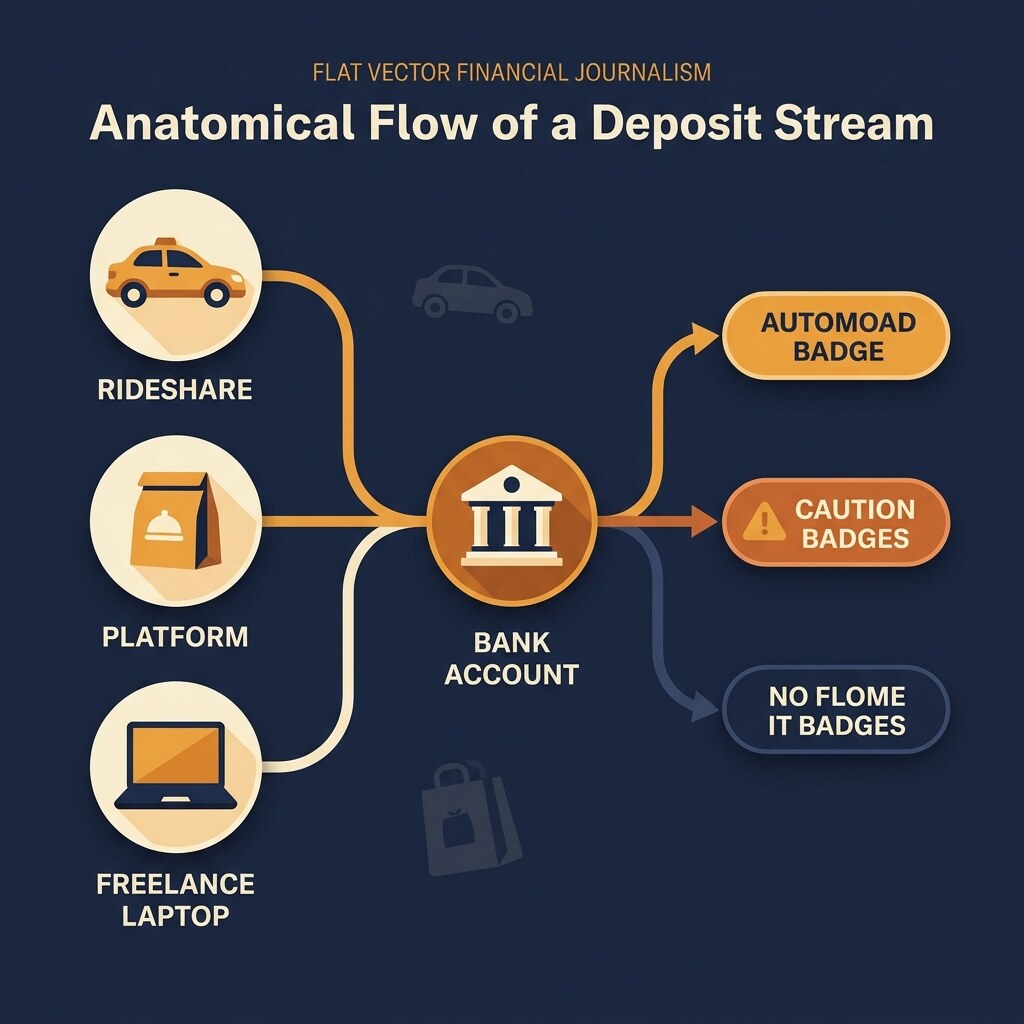
The underwriting backbone of most modern loan apps runs through Plaid's Income product or Finicity's Payroll solution. When Plaid Income is enabled for Payroll Income and Bank Income sources, it can surface labeled income streams from Uber, Lyft, DoorDash, and Instacart as recognized gig platforms rather than random transfers. That is progress. It is not a guarantee of approval.
Two problems persist. First, not every lender using Plaid turns Income on; many still use the basic Transactions endpoint, which sees "UBER BV 7734" as an inflow and cannot tell whether it is a driver payout, a rider refund, or a one-time credit. Second, Finicity's gig coverage is narrower than Plaid's, and apps like MoneyLion that use Finicity sometimes struggle with newer platforms. If your app is connecting through Plaid Income, your odds are materially better than if it is using basic Transactions.
Apps Built for 1099 Income
Giggle Finance
Giggle Finance underwrites specifically for 1099 earners. Advances run up to $10,000, approval is typically returned within minutes, and the decision engine pulls gig platform deposit history directly. It is worth flagging that Giggle is structured as a merchant cash advance product, not a traditional consumer installment loan, so the repayment mechanics (a fixed percentage of future deposits) and the cost disclosures look different from a standard APR. For a driver who has been told "deposits too inconsistent" by every other app, Giggle is often the first approval.
MoneyLion Instacash
MoneyLion's Instacash product uses Finicity and tolerates gig income reasonably well, particularly for Uber and DoorDash drivers with 60+ days of deposit history. Standard Instacash limits run $25 to $500 with no monthly fee required for smaller limits. Turbo delivery is $0.49 to $8.99. Higher advance limits kick in if you subscribe to RoarMoney ($1/mo) or Credit Builder Plus ($19.99/mo), which opens its own cost analysis (see whether the subscription fees are worth it).
Possible Finance
Possible is not a pure cash advance product. It is a short installment loan, typically $500 over 8 weeks, with flat fee pricing that lands at roughly $15 per $100 borrowed and effective APR in the 150 to 180% range depending on state. The trade-off is real: the loan is expensive compared to a credit card, but Possible reports to all three credit bureaus, which means on-time payment actually builds your file (most cash-advance products do not, as covered in do loan apps show up on your credit report). For a gig worker with thin credit, that matters more than saving $10 in fees.
OppLoans (OppFi)
OppFi offers installment loans up to $5,000 with no hard credit check, and has explicitly marketed to delivery drivers and rideshare workers. APR typically sits around 160 to 195% in states without rate caps. It is a price-of-last-resort product; use it only when cheaper options have said no.
Apps That Say They Accept Gig Workers but Rarely Approve Them
Earnin
Earnin's marketing is inclusive. Its verification is not. Work-email requirements, timesheet uploads, and fixed-location GPS checks combine to reject most rideshare and delivery workers before a human ever reviews the file. Some drivers get through by using an alternate email tied to a side job, but that is not a repeatable path.
Dave ExtraCash
Dave's algorithm looks for "qualifying deposits" of consistent amount and cadence. Gig drivers routinely fail that check because their weekly totals vary by 20 to 40%. A driver with $600/week in Uber deposits, give or take $150, may still see "we're not able to offer you ExtraCash at this time." That is not a rejection of gig work on paper; it is a rejection in practice.
Brigit
Brigit looks for three recurring deposits of similar size from the same source. Gig drivers who use one platform exclusively for 90+ days sometimes pass. Drivers running two or three platforms generally do not. Brigit's customer service will confirm this if asked directly.
| App | Accepts Gig Income | Underwriting Backbone | Max Advance / Loan | Fee Model |
|---|---|---|---|---|
| Giggle Finance | Yes (1099-first) | Proprietary + bank data | Up to $10,000 | Merchant cash advance fee |
| MoneyLion Instacash | Yes (partial) | Finicity | $25 to $500 base | Turbo fee, optional subscription |
| Possible Finance | Yes | Plaid | Up to $500 installment | ~$15 per $100, bureau reporting |
| OppLoans (OppFi) | Yes | Bank + alt data | Up to $5,000 | 160% to 195% APR |
| Earnin | Rarely | Work email + GPS | $100 to $750 | Tip + expedite |
| Dave | Rarely | Plaid Transactions | Up to $500 | Subscription + 5% fee |
| Brigit | Rarely | Plaid | Up to $250 | $8.99 to $14.99 monthly |
| Ualett | Yes (DoorDash-focused) | Platform integration | Varies | Per-advance fee |
What Happened to DasherDirect and What Replaced It
Payfare's DasherDirect program gave DoorDash drivers an instant-pay debit card with 2% cash back on gas and no fees on daily payouts. The DoorDash/Payfare contract was not renewed; the program wound down in early 2025 per PR Newswire filings and PYMNTS coverage. DoorDash has since moved to a new banking vendor, and Dashers now access instant pay through the updated in-app system. Third-party cash advance options (Giggle Finance, MoneyLion Instacash, Ualett) filled the gap for drivers who want more than the platform's own instant-pay.
If you are a Dasher who relied on DasherDirect, your cleanest 2026 stack is typically the new DoorDash instant-pay for daily earnings plus a separate 1099-friendly advance app for gap funding between sweeps.
The Paperwork Checklist Before You Apply
Ability-to-repay analysis for 1099 borrowers looks different from W-2. Lenders typically want to see 3 to 12 months of bank statements or a recent Schedule C rather than pay stubs (the IRS Self-Employed Tax Center is the canonical reference for what counts as 1099 documentation). Have these ready:
- Three to six months of bank statements showing gig platform deposits.
- Most recent Schedule C from your last filed return, if applicable.
- Platform earnings screenshots from the last 30 days (Uber Pro, DoorDash Earnings, Instacart Dashboard).
- A current driver's license and proof of address.
- EIN or SSN for identity verification; most apps accept SSN for sole proprietors.
Apps that ask for none of this are worth a second look. Not because the no-doc path is bad, but because the underwriting is then pricing in the uncertainty somewhere, and you want to know where.
Red Flags Specific to Gig Workers
- Tip-model apps that UX-default above zero. Pennsylvania's AG and the DC AG settled with SoLo Funds in 2024 on findings that pre-filled tips function as finance charges under state consumer law. If the app pre-fills a "donation" when you take an advance, you are being charged.
- Tribal lenders disguised as gig-friendly apps. Some apps market heavily to rideshare drivers and operate under tribal sovereign immunity, which means state rate caps do not apply. APR can exceed 400%. Check the loan agreement for "tribal" or the name of a federally recognized tribe.
- "Guaranteed approval" language. No legitimate lender guarantees approval. The phrase itself is a filter.
- Apps without a verifiable iOS or Android listing. Every app named in this article has a verified App Store and Google Play presence. If you cannot find the app in either store, do not install the APK.
California Gig Workers: DFPI Registration Changed the Landscape
California's Department of Financial Protection and Innovation finalized its earned wage access registration rules effective February 15, 2025. The rules cover EWA providers operating in California and impose registration, disclosure, and fee-cap requirements. Several apps withdrew or restructured California operations around that date. If you drive for Uber or Lyft in California, verify your app's current California availability directly before relying on it for a rent-week bridge.
Better Alternatives Worth Considering
- Credit-builder loans. Self and MoneyLion's Credit Builder Plus hold the loan proceeds in a locked account while you make payments. You end the term with savings and a reported tradeline, not a cash infusion. For drivers with thin credit, this is the single most leveraged move.
- Secured credit cards. A $200 secured card from Discover, Capital One, or Chime reports to all three bureaus and, used correctly, moves a thin file to a scorable file in six to nine months.
- Platform instant-pay. Uber Instant Pay, DoorDash Fast Pay, and Lyft Express Pay typically cost $0.50 to $1.99 per cash-out and skip the need for any advance app. For gap funding under $200, the platform's own rail is usually cheapest.
What This Means for Your Next Payout
The loan app category has started to recognize gig income, but most of it has not caught up yet. The apps built for 1099 earners (Giggle, Possible, Ualett) approve deposits that W-2-native apps quietly reject. The apps that reject you are not necessarily more expensive than the ones that approve you; sometimes they are cheaper, and you cannot use them. Shop the apps built for your income type first. Save the Earnin and Dave attempts for the day you land a W-2 side gig, because that is when their verification starts working in your favor.
Common questions from readers.
Short answers to the questions we get by email after this article publishes.
01 Which loan app is best for Uber and Lyft drivers?
Giggle Finance is the most common first approval for rideshare drivers, with advances up to $10,000 underwritten directly against platform deposit history. MoneyLion Instacash handles smaller $25 to $500 advances reasonably well for drivers with 60+ days of consistent deposits, and Possible Finance offers short installment loans that actually report to credit bureaus.
02 Why do Earnin and Dave reject gig workers?
Earnin verifies income through work email, timesheets, wage stubs, and GPS at a fixed workplace, none of which rideshare or delivery drivers have. Dave requires "qualifying deposits" of consistent amount and cadence, which gig income rarely matches because weekly earnings can swing 20 to 40%. The apps were built for W-2 biweekly pay, not 1099 variable payouts.
03 Can I get a loan with only DoorDash or Instacart income?
Yes. Giggle Finance, MoneyLion Instacash, Possible Finance, and OppLoans will underwrite 1099-only borrowers. Approval typically requires 3 to 6 months of platform deposit history in your connected bank account. Bringing a recent Schedule C or platform earnings screenshots strengthens the application, especially for higher advance limits or installment amounts above $1,000.
04 What happened to DasherDirect?
Payfare's DasherDirect program for DoorDash drivers wound down in early 2025 after the contract between Payfare and DoorDash was not renewed. DoorDash moved instant-pay to a new banking vendor inside the Dasher app. Drivers who used DasherDirect for daily payouts now access instant pay through the updated DoorDash system or third-party 1099-friendly advance apps.
05 Do gig worker loan apps report to the credit bureaus?
Most cash advance apps (Earnin, Dave, Brigit, MoneyLion Instacash) do not report to credit bureaus, which means on-time use does not build your score. Possible Finance and OppLoans do report, as does MoneyLion Credit Builder Plus. For a gig worker with thin credit, the reporting apps offer more long-term value than the no-report advance apps, even at higher APR.
Related articles
The True Cost of Loan Apps: APR, Origination, Subscription
 By Jordan Leventhal · 11 min
Are Loan App Subscription Fees Worth It? The Break-Even Math
By Jordan Leventhal · 10 min
Earned Wage Access: Employer-Partnered vs. Direct-to-Consumer
By Jordan Leventhal · 10 min